
← All plugins

Six Walls

Plugin · VST3, AU & AAX

The NanoFlux™

The non-reverb side of the original Alesis NanoVerb (unofficial) — chorus, flange, delay, gated reverb, and rotary — measured from a real unit and modeled warts and all. Plus Pawn Shop: the same box after a hard life and a previous owner’s soldering iron. Free for Windows and macOS.

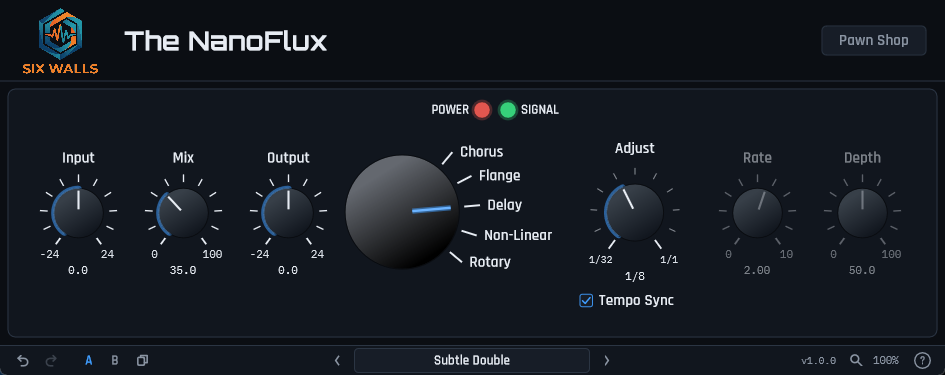
The NanoFlux plugin UI: Six Walls header with a Pawn Shop button, Input, Mix, and Output knobs, a five-position mode dial set to Delay, the Adjust knob reading 1/8 with Tempo Sync ticked beneath it, grayed-out Rate and Depth knobs, POWER and SIGNAL lights, and the standard Six Walls toolbar
Before you download Six Walls is one person building these in his spare time and giving them away.

Windows: the installers are code-signed — verified publisher Edwin Jones. A fresh signing certificate takes a little while to build reputation with SmartScreen, so for the first few weeks you may still see a “not commonly downloaded” note — click More info → Run anyway.

macOS: the .pkg and the bundle .zip are signed with a Developer ID and notarized by Apple, so they open with no Gatekeeper prompt. Universal — Apple silicon and Intel.
Watch It A quick introduction to The NanoFlux

Five programs from a real NanoVerb, each measured on the unit — sweep rates, delay times, filters, gate lengths, rotor patterns, the Mix pot’s own curve — and checked by ear against it, side by side, on real material. One Adjust knob per program, just like the hardware.

  • Chorus — true stereo: the two sides sweep at different speeds, from slow and deep to quick and subtle.
  • Flange — a feedback comb; at the bottom of the knob the sweep stops and it freezes into a fixed, metallic tone.
  • Delay — up to 1.27 s in the unit’s own 10 ms steps, or Tempo Sync: fourteen note values from 1/32 to 1/1, dotted and triplet included.
  • Non-Linear — the classic 1980s gated-reverb snare, from a tight 145 ms to a big 620 ms gate.
  • Rotary — a two-speed rotating speaker with the hardware’s quick spin-up and slow coast-down.
  • Turn Adjust all the way up for Custom Rate and Depth beyond what the front panel allows. Factory presets included, plus an Init – FX Send preset for effects channels.
  • Reports no latency to your DAW. The wet signal keeps the original’s own converter delay (about 1.4 ms), because that is part of how it sounds. Passes pluginval at strictness 10.

Hear it — each program, dry vs. The NanoFlux

Rendered through the plugin itself. The Non-Linear example was mixed in a DAW with the gate on the drums only.
Chorus · acoustic guitar
Dry
Slow & Wide
Flange · drum overheads
Dry
Jet Sweep
Delay · vocal
Dry
~360 ms
Non-Linear · the drums in a full mix
Dry
Tight Gate
Rotary · organ, slow → fast halfway
Dry
Rotary
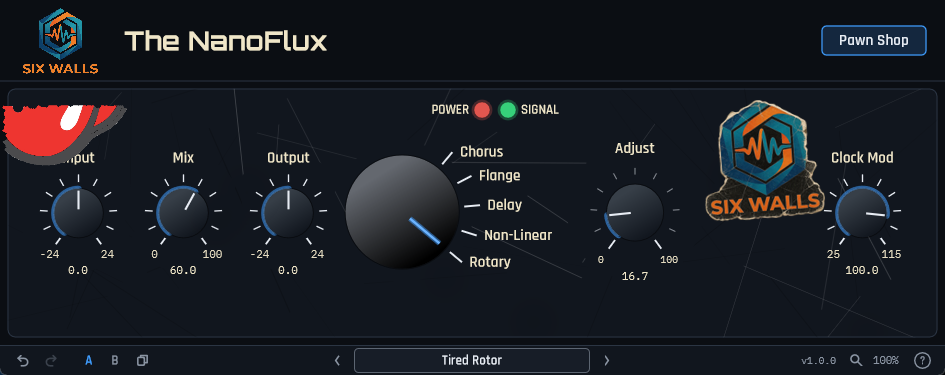
Pawn Shop The same box, after a few pawn shops. One button turns The NanoFlux into the bare hardware with every rough edge: crackly Input and Output pots, a slightly hot right side, chorus and flange sweeps that drift, a tired rotary motor that catches and drags, and raw delay-time jumps that splat when you move Adjust. And a Clock Mod knob drilled into the faceplate where Depth used to be — the most popular real NanoVerb circuit bend: slow the whole unit’s clock and everything stretches out darker and hissier; push it past 100 % and it starts to crackle.
The NanoFlux in Pawn Shop mode: scratched and scuffed panel, aged ivory lettering, a torn sticker, a worn Six Walls logo sticker, and a Clock Mod knob in place of Rate and Depth

Hear it — bass through Gated Sludge (Non-Linear on a 35 % clock)

Dry
Gated Sludge
VST3 AU AAX Windows macOS JUCE 8 v1.0.1

Get It! downloads the Six Walls Installer, the easiest way to install The NanoFlux, keep it up to date, and hear about new releases. Prefer to install plugins one at a time? Every platform’s installers and zips are under Individual downloads on the Support page. Full manual on the Support page.

Questions about The NanoFlux

What is The NanoFlux modeled on?

The non-reverb side of the Alesis NanoVerb (unofficial): Chorus, Flange, Delay, Non-Linear (the gated one), and Rotary. Each was measured on a real unit that Six Walls owns, then modeled warts and all.

What is different about this and the hardware?

Mostly things you wished the box had. Delay can sync to your project's tempo, and turning Adjust all the way clockwise gives you Custom, which unlocks Rate and Depth knobs the hardware doesn't have. You also get presets, undo, and A/B, and everything is automatable. Pawn Shop mode takes the extras away and gives you the bare hardware back.

Does the delay sync to my project's tempo?

Yes. In Delay mode, tick Tempo Sync under Adjust and the knob steps through note values at your host's tempo instead of milliseconds, from 1/32 up to a whole note, with triplets and dotted notes in between. It isn't available in Pawn Shop mode.

What is Pawn Shop mode?

The same unit after a hard life. Pots crackle when you turn Input or Output, the Chorus and Flange sweeps wander on their own, and the rotary motor occasionally stumbles. You get hardware controls only, plus a Clock Mod knob copied from the most popular real NanoVerb circuit bend: slow the clock and everything gets darker and hissier.

Is it really free, and what formats does it come in?

Free, no account, and no catch. VST3, AU, and AAX for Windows and macOS. The Six Walls Installer is the easiest way to get it and keep it updated, or you can grab individual installers from the Support page.

Disclaimer: Six Walls plugins are provided free of charge on an “as-is” basis — use them at your own risk, and always work on a copy of your session. Alesis and NanoVerb are trademarks of their respective owners; The NanoFlux is an unofficial model of a unit Six Walls owns and measured, not affiliated with or endorsed by Alesis or inMusic.